
I recently watched a TV cooking competition on YouTube. The judges asked the contestants to cook something which was a family tradition and reminded them of home.
One girl made scones. She told the judges that every day after school she went to her gran’s house, and her granny made the best scones. Her face lit up at the memory. Some days there would be a cheese scone with a bowl of homemade soup, sometimes a plain one with butter and a glass of milk, but her favourites were sweet and contained glace cherries. My mind was instantly cast back to my childhood, and memories of watching mum make scones.
My mother’s scones were famous. Sometimes long after I had left home, I would meet a stranger in Bridlington where she lived, who would stop and say “You must be Dorothy’s daughter,” and after a few pleasantries I would be told ‘she makes the most marvellous scones.’ Even now, many years after she died, a conversation about Mum includes the same reference.
I remember sitting at the table watching her hands rise and fall as she rubbed the fat into the flour and just like the contestant; they came both savoury and sweet and were a frequent after-school snack.
People who know the family assume she taught me how to make them, but she never did. In fact, she never taught me how to make anything. Right until she died, she assumed I couldn’t cook. In spite of that, my love of cooking and good food came from watching her.
The rise and fall of her hands in the rhythmic, almost hypnotic, way she rubbed in the fat, allowed the flour to fall back into the bowl in puffs and clouds gathering air as it went. I know now that’s why her scones were so light. She used different fats, butter or margarine, maybe lard or a mixture. Depending on whether they were sweet or savoury or may depending on what was available. The fat and the milk came straight from the fridge. They needed to be cold. There was always salt, and sugar, pinches and spoonfuls no weighing. No eggs, not even for the top. She brushed them with milk.
I believe she had made them so often that instinct played a bigger part than memory. The feel of flour told her if the fat was right. She eyeballed the liquid as she cut it into the dough with a knife, never hesitating or even looking too closely.
Once or twice, friends of hers have asked for her recipe, but even though I have her hand written recipe notebook, there is no mention of scones.
The scones that the cooking show contestant made from her granny’s recipe did not impress the judges. They were not rich enough, more like American biscuits. She served them with butter, not cream. They were too big and not refined, so they wouldn’t look good on a cake stand. They should have raisins, not glace cherries and more sugar.
One judge, finished with the comment, “Of course they taste fantastic but they are not traditional scones, so they don’t fit the brief. What makes a good TikTok story is not good enough here.” He then stuffed the remaining half scone into his mouth.
I watched the confusion on the girl’s face and was angry on her behalf. In the north of England, when me and this girl’s granny grew up, we didn’t have cream teas. TikTok hadn’t been invented and few of us had the money for afternoon tea in a posh hotel. (A tradition that originated in southern aristocratic houses.) Scones were a filling carbohydrate that were quick to make and filled hungry bellies.
Curious, I looked up the history. The modern recipes probably started in Scotland as a filling quick bread, the word scone originating from the word for lump or mass. Variations were made in Ireland and the north of England, all cooked on the fire or a griddle. With the invention of baking powder, quick breads and scones really took off and spread down the country, where no doubt they got fancier. The thing that struck me from this research is that the “traditional scone” doesn’t exist in one form because cooking simple flour doughs has happened since fire and grinding stones existed.
Fer goodness’ sake we can’t even agree on the pronunciation, let alone the recipe.
For reference Pru Leith’s technique bible suggests an egg wash but no egg in the dough and is sparse on the sugar, the Be-Ro recipe book (first published in 1923), from which many modern recipes originate, used an egg in the dough and on top and more sugar.
Mrs Beeton includes recipes for both dropped scones and baked scones, and suggests using sour milk and Modern practical cookery published around 1940, devotes twenty pages to scone recipes which include a variety of add-ins including candied cherries and mixed peel but are even meaner with sugar and fat than I remember and suggest a mix of milk and water to bring the dough together.
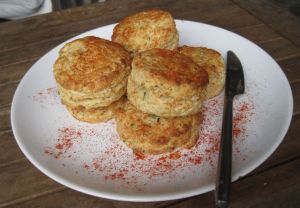
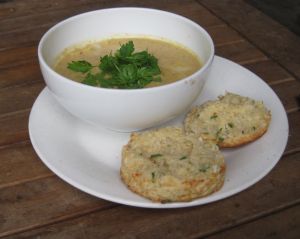
My recipe for cheesy scones, as shown in the pictures, is:
225 gm self-raising flour (I make my own)
30 gm butter
60gm grated hard cheese. (I like cheddar)
A hand full of snipped chives.
A pinch of salt and a teaspoon of sugar. (You don’t taste the sugar, but it gives a better crust and balances the flavour.)
Heat the oven to 200 C -190 if you have a fan oven
Rub the cheese and fat into the flour until you get a rubble like mixture. The butter disappears, but there will still be flecks of cheese.
Add the salt and sugar and chives.
Add the milk a spoonful at a time, mixing it in with a knife. When you have a clumpy mess, press together with your hands. It should come together in a ragged ball.
Remove from the bowl and shape into a ball on a floured work surface.
Flatten with your fingers until you have a round, flat disc and cut with a biscuit cutter. Re shaping the left over dough each time until you have seven or eight rounds. Put them on a baking tray and brush the tops with milk.
Remove from the oven when they are puffed and golden on top about 10 minutes.
Cool and sprinkle with chilli power.
They are not famous and I doubt people will talk about them after I am gone, but they do remind me of mum and some of the good parts of my childhood and straight from the oven with a bowl of homemade soup. They really can’t be beaten.
If you have enjoyed this post, why not read one of my books.

 Abigail Thorne
I’m going to bake a batch tomorrow. John loves scones, any variety.🤣 How arrogant those judges were, saying her scones wouldn’t suit high tea for the upper classes as they didn’t look nice. She must have been distraught.😟
LikeLike
I know I was really cross. Often it’s about fashion. Enjoy the scones.
LikeLike