
How to start writing after a break. Part 1
If we take time to build a writing habit, the story becomes ingrained in our minds . For example I wake up in the night sometimes thinking about my work in progress. When I’m out for walk I find plot solutions or resolutions for places where I’m stuck or have written myself into a corner. When you take a break, either volentary, a holiday for example, or involuntarily because of a family or health problem. It’s easy to lose the whole flow of the story.
So how do you pick it up again ? Where do you start. This subject is so pertinent to me, after being forced to take a break after my recent eye operation.
My initial plan and still a plan I recommend for starting again after a long break is to review your work, by reading. Do not and I repeat do not begin to edit or ift will be weeks before you surface again and you still won’t have a good overview of your work so far. After that make brief notes about what happens in the next the two chapters following the point you left off.
It’s worked for me before. It offers a slow start, reading and making notes. I must add here that It’s OK to throw away the outlines you have written. They are there to help start thinking creatively again. To draw you back into the story rather than give you a rigid framework.
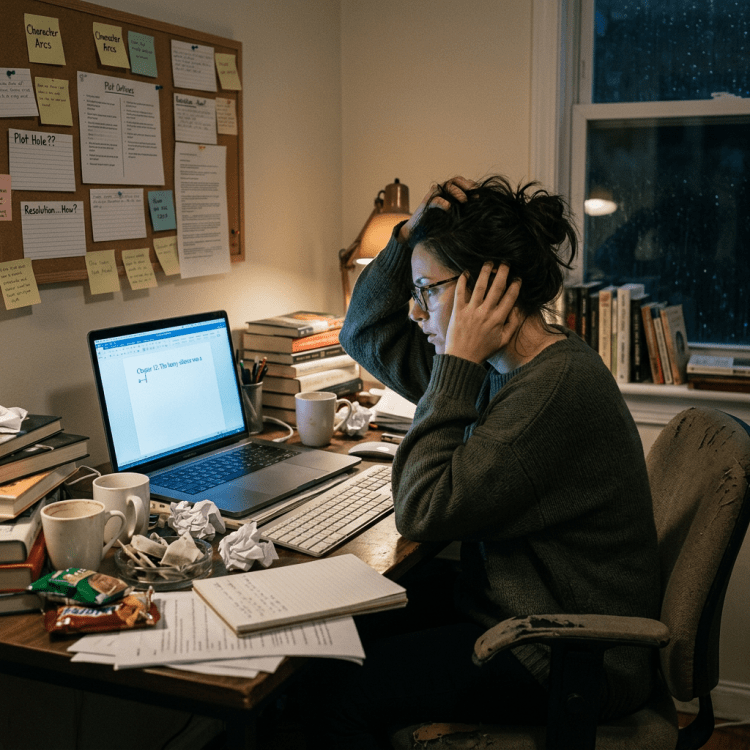
This time I thought it would be fun to find out what Copilot (windows built in AI) suggested. It came up with some brilliant ideas. As ever, it surprised me how helpful AI is now.
I tried the ideas the computer gave me and am offering you the results and my verdict. So here we go.
1) Write a returning to the story letter — from you to your book.
Not a chapter not a scene. A one page letter that begins with;
Here’s what I remember, Here’s what I think I was trying to do and here’s what I want this book to feel like,
This bypasses perfectionism and lets your brain reconnect with tone rather than plot.
So here it is my letter to my book.
Dear Corpse in the cafe,
I have missed you but I don’t remember exactly what we were doing together. This is what I do remember.
Esther and Dan found the body of a women they called the cat lady in the shop’s cafe. It was a very cold night and everyone believed that she had hidden in the shop to keep warm. Esther found a note from her suggesting that there was more to it and even hinting at murder.
Each clue that the cat lady left them led to another clue and it became treasure hunt round the grounds of a local stately home. Esther and Dan became suspicious of of the Earl who was currently lord of the manor, especially when the clues led to a body hidden in the family vault.
The earl convinced the police inspector who was in charge of the case. That the old lady suffered from dementia and both deaths were from natural causes. The case ground to a halt, with Esther struggling to accept the very plausible version of events. That’s as far as I have got,
Here’s what I was trying to do. I wanted to say that even smelly old cat ladies are important, and deserve treating seriously. Dan’s search for his birth father is the sub plot that illustrates the point
Here is what I want you book to feel like. It’s a treasure hunt, there is a puzzle to solve. Underlying that, are real issues, Esther guilt because she didn’t treat and old lady with respect. Dan’s need to find his roots and solve a thirty year old puzzle. And the the fact that money and a title can buy you more or less whatever you want. But I want you, my book to be gentle and humorous and not a campaign or a rant.
I hope this all makes more sense to you than it does to me.
With love Abigail.
It amazed me how effective this was, it got me back to my reasons for writing the story, and reminded me of the story without getting bogged down in detail. It also bypassed the fact that the first draught of most books is a hot mess, and rereading it can lead to being distracted by editing that needs doing
So suggestion one was a success. I’m keeping the letter to refer to when I do edit.
Look out for part two which is coming soon.
 Abigail Thorne