Broad Beans Part one

Image by Chris Reading from Pixabay

Because it’s Easter week, Steve has had a few days to work in the garden. I walked up there at the weekend and the size of the broad bean plants alarmed me.

Let me explain, last year we had a bumper broad bean crop. I struggle a bit with broad beans as a vegetable because they are fiddly to process. I like them double podded, and that takes time so I had a tendency to pick them and leave them in the fridge in favour of something easier. In the end, when we were sick of looking at them, there was no more room in the fridge and they were still coming. I had a freezer day. I froze them in gigantic bags. At Christmas, I took out a bag and thought I had used all of them. Last week, I found one of the previously mentioned gigantic bags full in the bottom of the freezer.

Rather alarmed that I would freeze this year’s before the last years were all eaten. I dug around my folder for recipes. I settled on the soup. The garden mint had had a bit of a growth spurt and would work well with them. Even half a bag would make soup for a week, meaning that they would be back in the freezer, albeit in a distinct form, fine until Steve got fed up of pots of soup for his lunch.

So for the other half of the bag, I decided on an experiment that I have been wanting to try for a while. I have a recipe for broad bean dip with middle eastern flavours that I rather like. The problem is that Steve is not a big dip fan. Every now and again he can be persuaded, but more often that not I am on my own. So a giant pot of dip would end up in the compost, wasted. I have been thinking how to dehydrate it so that I can make up small portions just for myself, or quickly if we decide to have crisps and a dip while we are watching a film.

The original recipe has lots of olive oil which will not dehydrate, so I made some alterations and played with possibilities until I came up with a winner. You can add olive oil, or Greek yoghurt at the end for an improved texture, but it tastes pretty good even without.

This week in part 1 is the soup recipe and a blow by blow account of the soup making process.

Next week, come back for the dip recipes, both the fresh version and the dehydrated.
The new crop will almost be ready to pick by the time you get the second recipe and you can try them even if you don’t have bags full lurking at the bottom of the freezer.
Take note, these recipes are both glut recipes. There are better things to do with the first vivid and vibrant pickings of spring.

This soup is very forgiving and so no need for weights or exact quantities

You will need.

1 onion

garlic to taste, optional
1 carrot
2 Sticks of celery
1 potato
500 ml to 1 litre of stock,
500 gm or more./ 1 pound double podded broad beans
Bunch of mint
Bunch of parsley
Knob of butter or extra olive oil.
Lemon juice, yoghurt, cream to taste

To get a beany tasting soup then one onion, one carrot and one medium potato needs about 500 gm or a pound of double podded beans. Don’t double pod, if the beans are tiny or you don’t mind the colour . The result will be less smooth, vibrant and fresh, but still comforting to take on a spring picnic.
I made mine in a pressure cooker, but there is no need it cooks happily on the stove.

Start with your base veg, one onion, one carrot and two sticks of celery if you have them. I didn’t have the celery, but I have some lovage in the garden, which I added with the mint towards the end, and it performed the same task.


Clean and chop the veg and fry in olive oil until all the vegetables are soft and the onion is translucent. Don’t let them colour as if will affect the final flavour.
Add the 500 ml stock and bring to the boil.
Peal and dice the potato and cook for 3 mins.
Add the beans, cook until the beans and potato are soft. Add the chopped herbs, salt and pepper and the butter or oil.
Liquidise, I used a hand blender, but a stand blender or a food processor are just as good.
Add extra stock if it’s too thick. The thickness will depend on how starchy your beans are,
Finish with yoghurt or cream and a squeeze of lemon to taste.
Eat hot or chill in the fridge for a summer soup.

Creating a character

Given that characters are the most important element in a story, it is quite reasonable for the reader to wonder where the character came from. I certainly do whenever I come across a character who has made me laugh or cry.

In a film, the writer depicts the character as ready-made. We like or dislike them almost from the beginning. Sometimes it even depends on the actor who plays that character and whether we warm to them.

Books aren’t like that. Books are more like real life where we learn about characters slowly, forming impressions that we later change. A talented writer shows us the character in small pieces, a glimpse of their appearance, then some personality so that we can build up an image in our own minds. Almost every reader sees each character differently and that is the beauty of reading.

It’s why films or books sometimes disappoint because the portrayals they give are so different from what we imagine. Although the reverse can also be true, the actor in the film makes us gasp as we see our favorite character come to life or that the film character becomes the character of our imagination. Think Harry Potter in recent times or Atticus Finch in To kill a Mockingbird. Could Morse in Colin Dexter’s detective series be anyone other than John Thaw? (Yes I know there is a series about the younger morse), but we all know that he grows up to be John Thaw.

When I wrote the Camino Murders, I didn’t know about creating characters. In fact, it’s only recently that I have read and watched videos to improve my skills. So when I created Miguel, he was there solely as a foil for Richard, the detective. By the time I wrote Mass Murder, I revolved the book around his weakness, and his trauma and make him into a much more human person.

So where do the characters come from? Some people start with a photograph like this one.

I can see the attraction of doing that, but for me, it always starts with a person. There is an old joke about not making friends with an author because you will end up in a book, and there is some truth to that. I start with a story, not the one that ends as a book but one that gives me some insight into a character and I build from there. Usually, the finished character bears no resemblance to the one that inspired them. But that first what if, when I see someone or hear an interesting story is where I start?

For example, back to Miguel. I have a friend here in Spain who was brought up in London. His parents were Galician, and he ended up speaking three languages. He is larger than life, has a house in the country, and has a long-suffering partner who is an angel. He is the basis for Miguel. I gave him a new image and turned him into a police officer. He isn’t recognizable by other people, although he knows, and nor is he meant to be, because I want my characters to be fictional.

I really know an artist who lives on the Camino Frances who used to be a police officer. He inspired Richard, but he is not Richard.

When someone annoys me, I often use them as the inspiration for a murder victim. Of course, by the time I write the book, the character is fictional, or rather they develop a back story of their own. But it still gives me enormous satisfaction to vent my anger by giving them a horrible death.

Sometimes I sit in a cafe and watch people come and go, characters develop from those chance encounters. My stores always start with a character.

I intend to come back to this subject with a closer look at how to build a character. For me, this year’s project is working out how I can make next year’s characters better, so I hope that you will join me on that journey.

A little bit of hope.

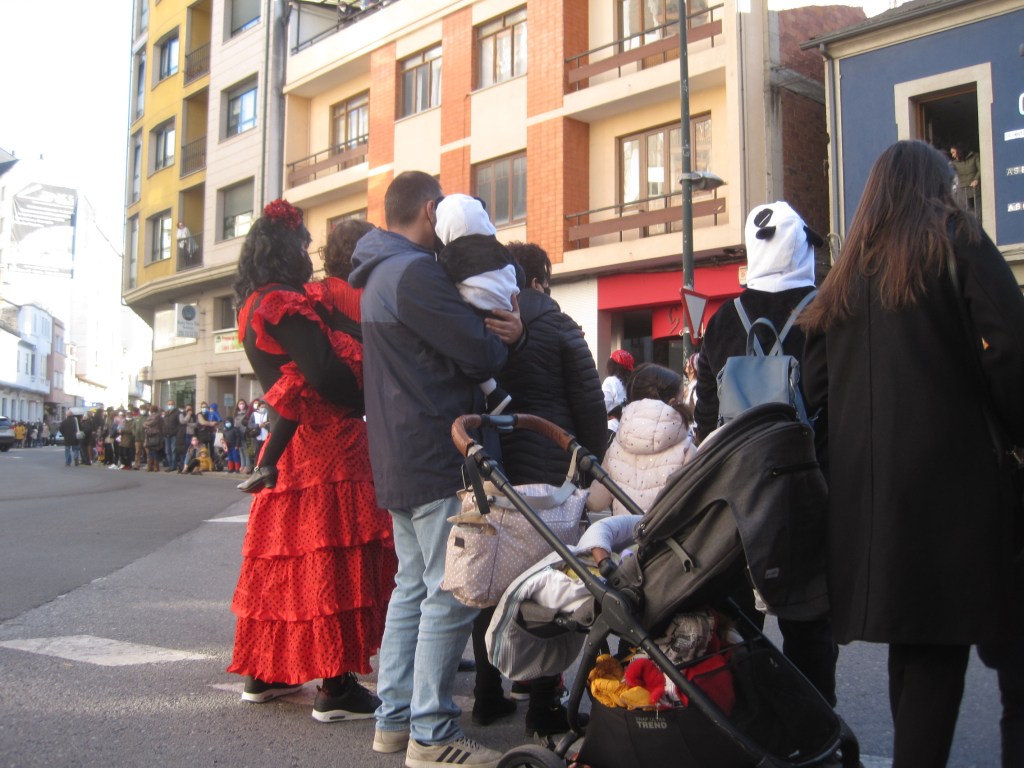
As usual, not only those in the carnival parade wear fancy dress. It was cold enough for me to wish I had a panda onesie over my clothes.

Over the last two weekends, we have seen a variety of carnival parades here in Galicia. In Sarria, we celebrated on Sunday, March 6 a little later than most towns locally because we had a bike race the week before. Last year the council canceled the parade altogether, and this year it was much smaller than it has been since we came here.

Carnival is as you probably know, is the last party before the lent fast. Few people fast during lent anymore, but the party goes on. Here in Galicia, the celebration is also connected to a much older Celtic festival that carries its own set of traditions. Typically, it is anarchical and riotous, with people crowding into bars and pushing and shoving to take photos. The floats are funny, political, and poke fun at the government, the church, and anyone else someone wants to take a pot shot at. There was less of that this year. We are not yet over covid and watch in despair at events in Ukraine.

But it happened! And those watching looked as I imagine a bear looks when it wakes up from its winter sleep. A bit surprised that the world exists at all. Glad to be out but finding it too cold and inhospitable to be out for long. I felt giddy as I do when I see a snowdrop or the first primroses on a muddy bank. Those tiny flowers carry on their shoulders the burden of hope for the future. A reminder that spring is around the corner and warmer weather will follow.

Next week Covid will still be here and sadly, more and more Ukrainians do not know where they will be. So now, more than most years, we need that hope, however small it might seem.

I needn’t have moved from my comfy chair.

There is always another use for a pushchair.

The British were being Royally laughed at.

It felt good to be there. One of the nice things about Spain is that the social life takes place on the street and when it does, you are instantly a part of the community.

News flash

Mass Murder has been revised and is once again available for sale.

The End and a Beginning

Can you get so fond of characters that you don’t want to let them go? Well, in my case, yes you can. Alex Whittaker started out as a practice character. I had only ever written a short story before and I wanted to try something longer, so I created Alex, a character with a real back story and some potential and then wrote a novella about her. That was almost the end of her. Writing a book of any length was quite difficult. And I wasn’t at all sure that I would continue. I didn’t know what genre I wanted to write or anything about self publishing.

Although I didn’t know what I was doing and got mixed up with genres and muddled on how to structure a series, I ended up with a trilogy. The Treasure of Saint Bee series. Common sense dictated that I leave it there.
Alex and her police officer fiancé finally got engaged after helping to solve at least three Murders and recover a treasure trove. Jerry left the police force for an exciting new job and they sent the bishop, who had caused so many problems for Alex, to prison after she discovered he was running a criminal network. A good place to finish, I thought.

You can find all those adventures here.

amazon

I have learnt so much about writing, story structure, genre and publishing that I wanted to write a new series. Full length this time and closer to the traditional murder mysteries I was aiming at.

Somehow, though, I ended up writing about Alex’s wedding. A short story just for my mailing list, I told myself. Thirty -six thousand words later, I ended up with Rings Bells and Murder. Because I had promised, my subscribers have already received a free copy and I’m making it available for free to anyone joining my mailing list before the end of June.

So Join here for your Free book

Processing…
Success! You're on the list.

Otherwise you can pre- order at your favourite bookstore. Only available in Ebook at the moment but paperback soon.

What’s next?

Well, I am so glad you asked.

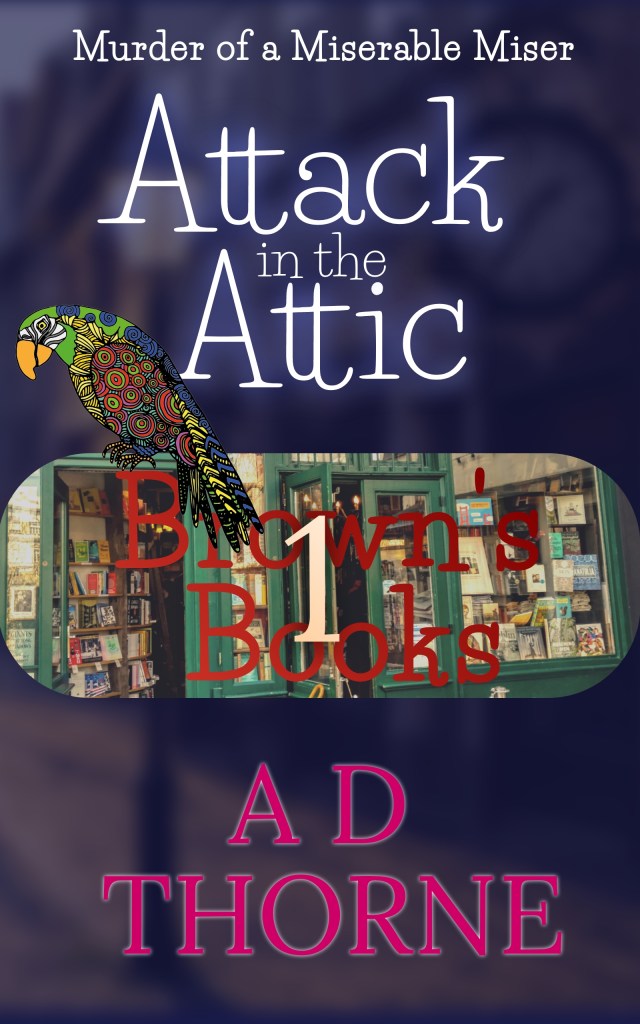
I am starting a new series call Browns Books. Traditional Cosy Mystery but this time much closer to what you might expect the genre to offer. I’m recycling characters and settings from the Book of Medicinal herbs. Well, we all know that we should recycle, don’t we?

Set in a rambling old secondhand book shop full of odd characters and with a mysterious death in every episode. I will include all of my favourite things. Cosy areas to sit and read, a cafe with homemade cake and a mystery solving owner who loves old books. Oh, and a parrot. I almost forgot about the parrot. Will you join me there?

cover provisional

Road trip, Podcasts and Special Offer

Road Trip.

I am sometimes wary of Road trips, hours sat in the car followed by the frustration of not finding what you are looking for. Or worse, finding it only to discover that everyone is doing the same thing and we spend the rest of the day in a line of traffic. This one however was of a different ilk. That said, it didn’t start well. I had printed off the information regarding all the recommended places of interest and had them in order in a folder which Steve promptly dropped, scattering the contents all over the car. They were no longer in any order reducing our chances of finding them at all. My lack of any sense of direction combined with Galicia’s reluctance to use signposts has led to more than one argument on a day out.

We arrived close enough to the first place to fire up google maps on my phone and sure enough after half an hour of wondering around unmarked back roads we came to a closed road. No way to proceed, and the lane too narrow to turn safely. So after some judicious reversing and a scarey three-point turn, we reviewed the situation.

“You must have got us lost again,” said Steve somewhat wearily.

The first place should have been some petroglyphs in a farmer’s field. I considered finding another route only to be asked why we were looking at a rock in a field, and decided to to try the second destination, an abandoned watermill situation in the Miño Biosphere Area of ecological interest. Something that we would both be interested in.

This time it all went smoothly, and we happily clambered around speculating how they had used the mechanism to cut marble. My only disappointment was that access to the river involved a metal ladder still damp from the morning dew. Another day, perhaps.

By this time there was no stopping us. All but one of our destinations would have been impossible to find, no signpost or even place name. So a huge thankyou to the people at Galicia Maxica. You are stars. There was no time to do the full route, there was so much to see and do. That and the coffee stops and a bit of tapas, and a picnic and other essentials. Well, you get the drift…

Podcasting find the podcast here

I have been trying my hand a podcasting, which is not as easy as it sounds. You can tell if you listen. It might be awhile before I call myself a Podcaster (Is that a word). But I am hoping to get better. My intention was to have audio files of my books so that you could listen and then buy the book on special offer. I tried a few times, but my voice won’t hold out for an entire chapter. It goes croaky then fades away so until I find a solution, I will offer some of the podcast in the artificial machine voice. I will keep you updated with my progress.

The Silver Chalice

This month’s Special Offer Is The Silver Chalice ebook, which for the next five days is available on Amazon UK for just 99p.

John walked into the big commercial kitchen and switched on the kettle, shivering as the steam spiralled into the air. The kitchen faced north, and the sun had not yet reached its small window. The cloth in his hand was for checking the stainless steel for marks. He sometimes wished they still had the tatty, friendly, domestic kitchen the environmental health people had deemed unfit for the purpose.
Now he was nervous of making finger marks, spilling crumbs, using the wrong colour cloth, or adding to a long list of sins he had already committed here. The church had to install a commercial kitchen in order to continue their midweek activities and lunches, and he had to admit the array of stainless steel looked very professional. The manager they appointed to ensure they met the regulations was a formidable woman who terrified him even more than his administrator, another formidable woman. Sylvie, his wife, teased him about him being afraid of his staff, something he tried to pretend wasn’t true, but he was a dreamer, a kind man who hated confrontation and preferred theology and prayer to administration. Everyone knew he was a visionary who sometimes lost sight of real life.
However, his mind today was not on scary staff or kitchen design, it was on Mike, his curate. He had arrived at church early to pray for him and spent an hour pacing back and forth in the church’s long central isle, a habit that helped him to pray and meditate before the church got busy. Besides, there was a spot halfway down the central isle which had an amazing echo, and John always gave in to a childish desire to hear his prayer repeated as it bounced off the walls.
Still focused on how to help Mike, he jumped at his phone alarm. It had been set to remind him to phone Alex before starting on the coffee. Without alarms, he lost track of time, so he set them for everything.
Having spoken to Alex, he hummed a tune to himself, relieved that she could join them for a few hours this morning. Mike had taken the illness of young Jamie Broadbent to heart, and Alex possessed a knack of putting pastoral issues into context.
He locked the sanctuary doors and made his way to the kitchen, moving automatically, pottering about, muttering as he knocked over the tub of sugar, while reaching to switch on the kettle.
He wondered if he should ask Alex to talk with Mike and help him through this. With her positive way of breaking news and explaining of the grief process, Mike might deal with his emotional turmoil.
“Yes, I’ll do just that,” he said, speaking to the boiling kettle, which whistled in reply.
Now Alex had removed the burden of pastoral work and he had gained a new vision for the church’s future. His enthusiasm had returned.
Humming quietly, he wandered around collecting trays, biscuits, and the odd assortment of mugs that the staff preferred to the church cups and saucers. The smell of coffee now mingled reassuringly with the lemon cleaning fluid he had used to mop up the spilt sugar. He breathed it in as he screwed on the lid of the big flask that would keep the coffee warm until the staff arrived.
There was an odd squeaking sound and a thump and he stopped, glanced at his watch and listened. How odd the building should be empty. Perhaps it was Joe the youth worker, in early to organise the youth room. The flask of coffee safely on the table, he walked through the hall to greet him.
“Hello is that you, Joe?”
As John arrived at the entrance, he noticed someone had broken the window and the lights were on. Something flashed in the sanctuary and realising that the glass doors were now open, he ran toward the altar.
“Hoy.” The word echoed.
As soon as he entered, he realised that there was someone moving around at the front; he moved closer to look, still unsure if it was one of the staff. No, something was wrong. The alter table was empty. The silverware wasn’t worth stealing; it was modern and not even silver, but it was was shiny, so maybe a thief wouldn’t know. All of this crossed his mind as he rushed to the front. It was probably kids. But as he got to the altar steps, a noise behind him caused him to jump, too late to see the pole before it cracked his skull. However, he watched it clatter to the ground before his vision blurred and he fell. Then he tried to shout, perhaps he did, maybe he didn’t, he wasn’t sure. He was still wondering when something bitter filled his mouth and he lost consciousness altogether.

Alex dropped her bag with a thud on the tiled floor of her hall. She needed sleep after an exhausting night, but there were things she needed to do first. Her mind was too active and disturbed to go straight to bed, anyway.
She wanted to talk to someone about the night’s events. Early mornings were busy for her friends and her boss. Either would understand her need to talk, her friend Jenny maybe? Jenny would be in the middle of getting her children dressed, breakfasted and to school. She imagined the chaos as they all piled into the car with their kit.
“Where did I put the coffee?” Her kitchen was tiny and well organised, but she was tired and couldn’t remember where she put the new pack after she had been shopping. Her heart sank again as she remembered James, the child who had died that morning. He would never attend school or take part in a family’s morning routine.
‘One disadvantage of singleness,’ she thought, ‘is being removed from someone to share.’ She sighed and giving up on coffee, made a cup of tea and took it to the front room. She lit the gas fire to temper the early morning chill, then curled up on the sofa to think through the events.
Pastoral work was the most fulfilling and the most troublesome part of her job. She was quiet and listened when caring for people, and hearing their stories gave her enough satisfaction to know she was in the right place. Although all clergy had to tackle anything, the church threw at them; they paid her to do the lion’s share of the pastoral work in her role as associate vicar.
Last night had been terrible, much more traumatic than the things she normally dealt with. Three-year-old James had contracted meningitis a month ago. The extended battle to save his life had been an emotional one. He had lost that battle at five this morning; Alex had held the hands of his parents until he passed away, well aware of the privilege of being with people in their private moments. She knew supporting them in their grief fulfilled her calling more than any of the other jobs she did. Although certain of God she felt inadequate, never had the right words, but still her presence was important. She held their hands, took the brunt of their anger, shouldered their sorrow, and prayed their prayers, then came away knowing she carried a small part of their grief and knew she was in the right place. Just as often, she shared the best moments of people’s lives, their joy, and celebration, and to see their prayers answered.
‘It’s the public parts of church ministry that are difficult,’ she thought, returning to the kitchen for some biscuits.
That was why running her own parish, doing everything they needed herself proved too much. The congregation expected her to meet, using magic if necessary, all of their various wants and needs.
She still struggled with some things, preaching for example. Mike, the curate at Saint Stephen’s, who seemed to do everything well, said he “tuned into the holy spirit” and didn’t need to prepare at all. Whereas Alex was often sick before she led a service; her hands shook as she distributed the Eucharist. PCC meetings gave her hives, and she found Deanery Synod meetings as dry as the Atacama Desert, but with less life. Many of her colleagues loved the showmanship of the upfront parts of church ministry. Alex an introvert wondered if she was a fraud, a misfit who should do something else, and it spoilt her enjoyment.
An hour later, a half-full mug of lukewarm tea still in her hand, the ringing phone woke her with a start. It was John, her boss, and rector of Saint Stephen’s.
“Was it a terrible night? I heard the news about James from the hospital.”
“The worst,” she replied, already fighting tears.
“I’m going to the hospital myself once they have done the official paperwork, they are expecting me at about eleven. Do you want to talk, or sleep?”
“I’m coming to the staff meeting.” Alex decided as she spoke. “I’d rather the staff heard the story firsthand before the rumour mill gets going.” The church, like any other community, thrived on gossip.
“It’s true, it’s bound to be rough.” The hesitation in John’s voice suggested he wanted to spare her the staff meeting. But he knew her reasons for going were sound.
“I’m already here, so I’ll get Giles to pick you up in ten minutes. That will give me a chance to make coffee for everyone. I’ll drop you back home on my way to the hospital, that way no one can button-hole you after the meeting.”
“Thank you so much, John.” Alex knew she was lucky to have such a thoughtful boss.
Ten minutes wasn’t enough time for a shower or to get changed, but she washed her face and cleaned her teeth. Her cropped hair needed very little attention. She was still wearing her clericals, which made her uncomfortable. She was a Jeans and t-shirt person given a choice, uncomfortable in formal clothes. Even though she chose pretty coloured shirts to go with her dog collar, they still felt starchy. The few minutes sleep she managed would suffice for a couple of hours, soon she would be home in bed.
Alex dreaded staff meetings. They were always a bit testosterone-fuelled and competitive. Big evangelical churches attract big personalities, type A people who love being in charge. Often staff who had held management jobs in a previous life kept a corporate attitude to church life. They transferred their skills and expectations to managing the congregation and staff.
Alex was the newest member, having been in this job since Christmas. Before her ordination as a freelance travel writer, she didn’t go to business meetings. All her management and ministry experience came from her previous churches; both smaller; and neither with a staff team.
She liked everyone, but the challenge was holding her own as part of the group. The meetings discouraged her, however determined she was to enjoy them. Sometimes she failed to get her point across, sometimes she lost out jostling for a position in the pecking order.
The staff at Saint Stephen’s was big because the congregation was big and growing. Youth workers and children’s workers enabled the church to keep its family-friendly atmosphere. Admin staff meant the clergy were better able to deal with more spiritual matters. The building was a hub of community activity.
In charge of everything was the reverend John Jeffrey. An experienced priest who had served Saint Stephen’s for twenty years. One reason Alex took this job was because she admired John’s wisdom and gentle leadership style.
In control of the office was Judy Fulshaw. The administrator. An older single lady, encased in tweed and an excellent administrator. She had rebuffed Alex’s attempts at friendship so far, and that too had dented her confidence.
They held the staff meetings on a Monday morning, but today her tiredness outweighed her fears. ‘I’ll tell everyone the sad news that little James has died, persuade Judy to cancel my appointments, and come home to bed,’ she thought, as she put on her jacket.

The meeting didn’t happen. Judy was waiting for them on the church steps, walking backwards and forwards and peering into the car park.
“Someone has broken in,” Judy pointed at the broken window.
The town and the diocese built the church in the 1970s to replace the one that was now under the ring road. It had glass doors leading to a spacious lobby before you reached the sanctuary itself. Very modern at the time and too showy to be practical.
“Are the doors open, Judy?” asked Alex.
The sanctuary was also typical of the era. It was almost circular with a small chapel, choir vestry, and vicars vestry cutting into one side. A row of modern-art-style stained glass windows, set at different angles on the other.
“The sanctuary doors are open, Judy, have you been in’?” asked Alex, looking toward the altar.
The front had a raised altar area, the organ, and space for a music group. They had partitioned part of the back for a sound desk, modern lighting, and electrical equipment. There was seating for six hundred people with stacked folding chairs for another hundred.
“Nn…no, I’ve done nothing,” Judy said, far from her normal brisk self.
“Has anyone phoned the police?” asked Giles, striding forward. “We had better check the damage and see what’s missing.”
Giles was the building manager. He was an aerospace engineer, who had held a senior management position for a well-known company until he retired. He now worked part time for Saint Stephen’s, overseeing the church building itself, the staff housing, and much of the financial accounting.
“I haven’t called the police yet, I was waiting for you.” replied Judy.
Giles took command and was already heading for the front of the church. “I’ll do it,” he said, phone in hand.
Judy followed him in to check the sound desk and then the altar area. Giles went to check the vestry and band area, where they kept the safe and any other valuables. Alex stayed in the lobby to prevent anyone else from entering before the police arrived.
Gazing around the lobby, something seemed wrong. She had no experience of break-ins and didn’t know what was normal, so she wasn’t sure what bothered her. She looked at the lobby and the broken window again. There was loose glass on all four sides of the frame.
‘A thief would knock it out, either first, to prevent cuts, or in climbing through,’ she thought to herself. She took a quick photo on her phone. She also took photos of the glass on the lobby floor and on the step outside. Something about that also disturbed her. The pattern didn’t seem right.
A piercing scream interrupted her. She rushed down the central isle to the front of the altar area where Judy was standing. There on the floor, sprawled halfway up the altar steps, was John. Blood covered the polished wood around his head and dripped from the top step. There was no movement. The sight had frozen Judy on the spot. Alex pushed past to check for a pulse and found none. John’s body felt warm to the touch, but it was cooling and the blood was clotting. She placed her fingers on his neck to be sure, but there was nothing. She collapsed backwards away from the body, overwhelmed with emotion.
Giles re-emerged from the vestry, separated from the church itself by a bathroom and a set of cupboards. The cupboards were full of unused vestments and church linen, which had deadened the sound from the church, and Judy’s scream.
“The police will be an hour, we need to close the building.” he said, stopping short when he saw the women.
Alex looked up. “Ring them and for an ask ambulance, no hurry. I’m certain it’s too late.” She sat on the steps next to John, not wanting to leave him alone.
‘No one should die alone,’ she thought.
“Yes, I’ll do that.” Giles, white faced and hands shaking, dialled 999. This time, the operator told him that the squad car and ambulance were coming. They needed to clear the area and ensure that no one else could get close. He took Alex’s arm.
“Come on. Let’s return to the lobby,” he said, moving her.
“I don’t think he wants to be alone,”
“I don’t think he is alone anymore, Alex. He’s gone somewhere better, don’t you think?”
She nodded and stood up.
Judy hadn’t moved or spoken and her expression was unreadable, but she followed them to the lobby when Giles told her to.
They arrived at the door in time to admit police and the ambulance crew, who arrived shortly after.
Alex had recovered her composure by the time they reached the door. Other staff, the caretaker, and a member of the congregation were arriving.
“I’ll tell them to go home,” said Giles.
“No,” said Alex. “The next few days will be tough enough, let’s ask for help.”
Judy was shaking. Alex put a hand on her shoulder. “I didn’t know about John,” she said.
“Of course not, how could you?”
Alex turned to Giles.
“If we can, we’ll gather everyone in the church hall and give them a job to do. We must prepare ourselves for when people hear the news.” Turning to Judy, “Please can you check the office and the church hall, use the side door, not the lobby. There might be evidence, so be careful not to touch.” Alex smiled and nodded.
Judy returned with the news that the church hall and the office appeared to be OK.
Alex turned to the police officers and held out her hand.
“Alex Whittaker,” The officer took her hand.
“Officers Dickens and Wright, Reverend Whittaker. Inspector Portman is on his way.” He showed which of them was which.
“Would it be OK for the staff to wait in the church hall? It’s separate. The thieves didn’t break into the hall, the door is locked. They can use the side door to keep the lobby clear.”
The two police constables shared a glance.
“I’ll go with them,” said Constable Wright. “The inspector will want us to keep everyone together. Who has the keys?” She asked, holding out her hand, her tone brooking no argument. Judy produced the keys and handed them over.
In the meantime, Giles had directed the ambulance staff to where John lay. They had confirmed his death and were waiting for the police inspector and surgeon.
Alex was alone again.

Inspired by Authors Past.

The lock-down, the weather, the lack of opportunity to meet with friends’ and uncertainty about future finances have all had a dampening effect on my creativity. I claim to exist in a bit of a vacuum, happy with my own company and with such an overblown and vivid imagination that I never run out of ideas for stories.
In comparison with many of my friends, that is true. I guess, I’m finding out now that we all have our limits of being alone and going nowhere. For the last few weeks, the Internet and random TV shows I would never normally watch, have distracted me.

Victorian Britain

It was when I was randomly surfing the net that I came upon a brief article about Charles Dickens and his relationship with Great Ormond Street Hospital. He was one of its first and greatest benefactors, but that is another story.

We learnt about Charles Dickens at school; I expect most of you did too. We read parts of his novels and the teacher gave us a rather bare biography. It was enough to put most of my friends off completely.

I wish we had learnt about his social politics, or even his affairs, or that someone had set his stories in context.
For those of us not put off, it was probably either subsequent films (who can forget Oliver Twist asking for more?) or some of his more eloquent quotes.
For me it was the unforgettable nature of his first lines

It was the best of times, it was the worst of times. Tale of two cities.

Marley was dead, to begin with. The Christmas Carol.

Whether I shall turn out to be the hero of my own life, or whether that station will be held by anybody else, these pages must show. David Copperfield.

I realised as I was flicking through various biographies, that as a for me as a writer there was a lot in Dickens’ life to inspire me.

Not least that my grammar corrector dislikes his writing intensely.

He lacked much in the way of formal education, largely because when Dickens was a teenager they sent his father to debtor’s prison and Charles had to leave school to work in a factory. Even then, though, he was aware of the social injustice of the time. He knew they would free his father if the family could pay off his debts. For many of his contemporaries, there was no escaping their poverty.

All of his work was about social injustice, either as essays, journalistic pieces or novels. He studied writing and other writers not to perfect his writing as an art form, but in order to get his political point across.

Two of the things he learnt from Shakespeare’s plays were of particular relevance for this. Comic caricature and the use of emotion and sentimentality, from that point on only the primary characters in his stories were rounded or realistic. The others were there to make a point. He learnt to use words to manipulate his reader. Many writers achieve this occasionally, very few can do it at will. Dickens studied this art and then exploited it. There was no effortless artistry about his writing, everything in there was deliberate.
He split the opinion of the literary world on this point, his work was too comic, too sentimental, and he borrowed ideas and concepts and used them and worse he was popular. Art for the sake of art, and effortless talent without study or marketing, was preferable.

In much the same way, years later, Harold Abrahams would split the opinion of the Athletic world when he used a professional trainer, removing the fairy tale for good that you only need talent and breeding. Those two things help, but hard work makes you stand out from the rest.

That he almost became an actor, auditioning for parts in well know plays, might explain some of this. Much of his popularity and indeed his wealth came from his public and dramatic reading of his stories, not the stories themselves.
His books were almost all published in episode form, and he studied the art of the cliffhanger because of that, knowing that he wanted his stories to sell. The result of this is that whatever the opinion of literary critics, he was extremely popular with the public.
Much less in his favour was his tendency to be verbose. But then he was paid by the word, why use one word when you can easily use three.
I have to wonder also how someone with ten children, who’s marriage ended because of his many affairs, had time and energy to write at all. Perhaps that’s what sparked his creativity.
Sadly, this is not something that I can test for myself. But may some of you younger writers might take note.
In the meantime, I am going away to work on creating amazing first lines and to learn the art of emotional manipulation.

Landscape stories: The swimming hole

The countryside around my house is like many rural areas in Spain, gradually emptying there is, however, evidence of a former dying lifestyle. People lived on small farms, anything from a single acre. This was subsistence farming where families produced everything in the house or at least the village and money rarely changed hands.

Today’s story was told to me by my neighbour, passed down from her husband’s great grandfather lets call him José for the Story.

The Swimming Hole.

José stood and looked at his bottom field, wondering what on earth he should do. He needed more usable land, and this field was a good size and fairly flat, a real bonus in this hilly country. The problem was it flooded in the winter and was bone dry in the summer. No use for crops. A wet spring and the seeds rotted, and a week of scorching sun killed anything that survived. The cows wouldn’t eat the coarse grass and the damp clay soil caused foot rot in his sheep.
What he needed was an irrigation system that drained the field in the winter and irrigated it in the summer. The water was in the wrong place. A stream ran through the neighbouring woodland and ran along the bottom of the field, forming a lake in winter and spring.
He walked into his field and came up with an idea. If he could dam the stream before the water reached his field and built a small reservoir. He would need to dig out the bottom stream as a drainage ditch and put an irrigation ditch higher up, and he could regulate the flow through the field.
Having made a plan, he needed to find someone to help with the work. His only son was too young to help.
It was customary for everyone to help each other with extensive projects like this one, so he raised it at the next village meeting. Some people sceptical. The plan would benefit him, but no one else had fields that close to the border of the neighbouring parish. It looked too complicated to work. Even with objections, they listed the project and José dug the channels.
The village was tiny, with only six families, so when something happened to one family everyone helped. That winter was a bad one, and one family in the village lost a part of their barn roof. It took the men months to fix it so Jose’s reservoir didn’t get done. The wet summer meant twice the work to make the hay; the winter saw sickness in the animals and the following summer a fire. Two years passed and José still had no reservoir. He had finished his drainage ditches, which had already helped the situation, but he wanted to finish the job.


He had an idea, his son was now a teenager. What if he made the reservoir with straight sides so the teenage boys could use it as a swimming pool? Would they help him dig it out and lay the stones? He showed his son what he wanted to do and asked him to talk to his friends. That weekend twenty boys turned up to help and the next weekend even more. In no time at all they had dug a pool and built sluice gates.

Stone sides


José and his family threw a big party for the village, the women baked empanada’s and they sat in the woods by the pool while the children had a great time swimming in the water.
The pool in its woodland location became a popular courting spot and remained so even after the reservoir fell into disuse. My neighbour can’t remember it being used, it probably took too much work to maintain it, but he can tell me about couples who did their courting there, and his mother remembers swimming when she was a child.
Now it has almost disappeared, and stories like this disappear with it, claimed back by nature.

The approach

How lovely to have a swimming pool, though, in the dappled light of the woods? I can only listen to stories and dream.

The Mystery of the Wooden box.

Out now is Book 3 and the last Treasure of Saint Bee.

Find what happens to Jerry and Alex.

Who was behind all the trouble?

What happens when you find a body on a mountain.

The story behind New Year’s Resolutions.

It was the Babylonians who made the first formal recorded New Year’s resolutions 4000 years ago. In case you don’t know: They built the city of Babylon near the Euphrates river in Mesopotamia. You can find the ruins of the ancient city in modern day Iraq. (Before the war, now I’m not so sure)

The Babylonians held a new year festival lasting for twelve days in mid-march, for the start of the lunar calendar and time of fresh growth. The primary purpose of the festival was for citizens to either pledge their allegiance to the current king or to crown a new one, in those days the kings had a short lifespan. As it was a religious culture, it was time to appease the gods. In order to do that, it was important to pay your debts and return anything that you had borrowed the previous year in order to start the new year afresh. This ensured that you could concentrate on growing crops that would prosper. It helped if you got your plough back, and that sack of seed potatoes that Jim borrowed, and the meadow down by the river where Fred had been grazing his sheep, and the shears that the new guy at the end of the lane had.

Think about that for a minute, each year you pay all your debts, financial or otherwise, return everything you have borrowed and start the new year with a clean slate. Not such a bad tradition.

The new year didn’t move to January 1st until Julius Caesar took charge of the roman empire in 46BC. The Romans followed a lunar calender, and it was out of sync with the moon. So much so that if he travelled around his empire, he never knew in which month he would arrive. Difficult travel hadn’t caused this, it was because people couldn’t keep track of the date using the moon. He hired astronomer’s and mathematician’s to calculate a new calender based on the sun, not the moon.

To celebrate he named the first month after Janus the two faced god, who could look both back to the past and forward to the future. There would be a party, during which every citizen promised good conduct.

See how sneaky he was, an annual holiday in exchange for promising to behave to follow whatever rules he dreamed up, and he dreamed up quite a few. Does this sound a bit like Santa Claus? I think his equivalent of a piece of coal in your stocking was very, very nasty.

Although most of the Western world changed to the new calender, the roman Catholic church didn’t accept the new year date of January 1st. Because the new calendar wasn’t accurate enough, and once again didn’t always match either with either the lunar or the solar cycle.

In 1582, the pope ordered the calculation of a new calendar, and this new Gregorian calendar is the one we use today. The new year celebrations with the resolutions, of promised good conduct, from the romans, and renewed purity from Pope Greggory continued as a tradition, even when the political and religious overtones had been disregarded.

You can see where these twin resolutions fit into modern life. Purity being interpreted as health and education and good conduct as kindness and voluntary action. These make up our most popular resolutions today.

Lose weight

Do more exercise

Save more money

Join a voluntary organisation

Improve family time.

Self improvement playing a much smaller part in new in other parts of the world, for example China where certain foods and actions bring good luck and cleaning and buying new clothes signify change.

Any one who has time to clean is not reading enough.

In Iraq, where it all started, they have three different new year Celebrations, Christian, Muslim and Kurdish or traditional. There is nothing like hedging your bets.

Medieval knights vowed on a peacock to keep the laws of chivalry… and then ate the peacock.

Within the Christian church, New Year’s resolutions became a serious part of the yearly cycle, thanks to two people.

John Wesley created a new year service now called a watch night service but which he called a covenant renewal service. The purpose of which was to pray and renew your covenant with God.

Johnathan Edwards, the evangelist not the athlete, took New Year’s resolutions so seriously that he took two years and wrote 70 resolutions to live by.

Including, and I like these,

5. Resolved, never to lose one moment of time; but improve it the most profitable way I

possibly can.

6. Resolved, to live with all my might, while I do live.

7. Resolved, never to do anything, which I should be afraid to do, if it were the last hour of my life.

8. Resolved, to act, in all respects, both speaking and doing, as if nobody had been so vile as I, and as if I had committed the same sins, or had the same infirmities or failings as others; and that I will let the knowledge of their failings promote nothing but shame in myself…

Are there any celebrity resolutions? Well, there are a few, but when it comes down to it we are all pretty much the same, only the place or manner in which we make the resolutions change according to our status, wealth or religious belief.

So what will you resolve to do? Covid regulations have denied most of us the lavish party, or even the watch night service with friends.

You could always fall back on the peacock!

In fact, that’s my first resolution: Get a peacock. You never know when you’ll need one!

One Million Word Challange.

When I started writing, I was very excited about it; I loved the process and felt in my heart that here was something I could be good at. My enthusiasm met very mixed reactions. Some people were excited for me, some had scepticism written all over their faces. Some bluntly told me I was no good.

I spent a good deal of time thinking about what to do. Should I only write in secret? Or stop all together. At first, they were my only options; I don’t have a great deal of self-confidence and in the past backed away from something if someone told me I was incapable of doing it. I am afraid of being laughed at.

This time it felt different. I love the process of writing, and I want to write books and earn a living from it. I then came across this quote. You can’t call yourself an author until you have written one million words. The combined minds of the internet attribute the quote to several authors in several forms. To me, it was the answer to my dilemma. I can tell people I will decide about my ability once I have published one million words.

I now needed a commercial goal. At what point will I have failed commercially? I didn’t want to set a financial target, partly because there are too many variables, partly because I have no direct control over who buys my work. So, I decided on a specific number of books. The number would have to be greater that twelve, because it was going to take me a million words to become competent to write. The first few books might sell a few copies, but probably wouldn’t count toward commercial success. I settled on twenty.

I am sure by now you realise that I think too much and in a rather convoluted way. But I now have an answer for people. I won’t stop writing before I reach one million words and I will have neither succeeded nor failed before I have written twenty books.

The one thing I hadn’t counted on is becoming addicted. Writing is like a drug: the more you do, the more hooked you become. Soon I will have to answer the question, “Can I stop?” I suspect that the answer will be; only with treatment.